
How glorious it is to see Worstall’s Fallacy alive and well in The Guardian
Worstall’s Fallacy is to demand what must be done without taking account of what is already done. A typical example would be to insist that much more must be done for the poor - which could be true, of course it could - while not including, in the calculation of how big and urgent the problem is, what is already done for the poor. A more concrete example would be that usual shrieking that child poverty rates in the United States are well over 20% - which is the number before the US welfare system kicks into action. The number after it has done so is more like 2 or 3%. Both in the slightly different, odd even, manner that the US itself measures poverty.
Note that the Fallacy is nothing, at all, to do with what it is righteous to have as a goal. It’s purely about not taking into account what is already done in attempting to reach it when indignantly demanding that something be done.
The Guardian decides to take said Fallacy out for a walk - in fact, given the centrality of it to this column, a proper gallop. Eduardo Porter tells us that:
The Chinese did rather well in the age of globalization. In 1990, 943 million people there lived on less than $3 a day measured in 2021 dollars – 83% of the population, according to the World Bank. By 2019, the number was brought down to zero. Unfortunately, the United States was not as successful. More than 4 million Americans – 1.25% of the population – must make ends meet with less than $3 a day, more than three times as many as 35 years ago.
Ah.
But this story ignores how the US chooses to spend its riches. It seems reasonable that the success of a society and its system of government, the morality of its political compromises and agreements, would be determined to an important degree by how it chooses to deploy the fruits of its accomplishments and how it apportions the costs of its failures. Unlike China, the US did not offer much to the people eking out a living around the poverty line. Per head, the US’s economic output is six times China’s, and yet, inexplicably, there seem to be more abjectly poor Americans than Chinese.
Hmm.
These days, Americans in the poorest 10th of the population draw about 1.8% of the nation’s income, about the same as poor Bolivians.
No. That last one we know is wrong just off the top of our heads. The poorest 10% of the US gain about 5.2, 5.3% of the national income. You can say anything you like about the justice in the poor gaining one twentieth of the national income just as you can about their gaining one fiftieth. But a twentieth and a fiftieth are very different numbers, no?
The error is in using the World Bank numbers which are themselves based upon the Luxembourg Income Study.
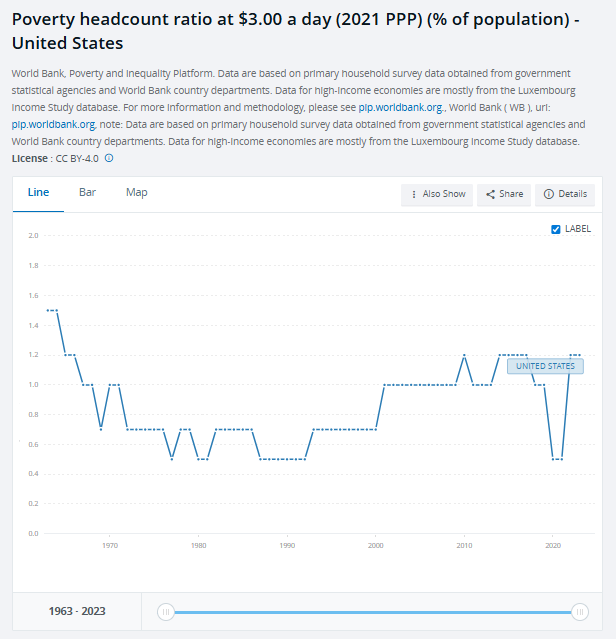
This particular measure of poverty rises as the Clinton welfare reforms kick in and cash welfare payments generally stop. That bounce down during lockdown is because there was a significant revival in cash payments at that time.
But the American poverty alleviation system generally does not depend upon cash payments. Rather, upon the delivery of goods and services in kind. Food stamps, Section 8 housing vouchers, free medical care with Medicaid. Further, US Census does not include as income anything that arrives through the tax system - so the Earned Income Tax Credit is generally not included in those calculations of the income of the poor. It’s most certainly not in the calculations of those under the US poverty line rather than this $3 a day one.
We also have the LIS definition of disposable income to consider, here.
Specifically, we do not include non-monetary transfers in the areas of housing, care (including child care), education, or health.
The US system depends upon these much more than other systems for that poverty alleviation. Not including them grossly overstates poverty in the US.
Not that Medicaid goes only to that poorest 10% of the population but that one programme alone is about 3% of US GDP.
We’ve no idea how the Chinese numbers are compiled. But the American ones are - largely - of market incomes before the welfare state swings into action. They most certainly are not the true ones after whatever work the US does to alleviate poverty. Thus the central contention here is wrong.
But still, how nice to see Worstall’s Fallacy taken out for a ride again. Mr. Porter has worked for the New York Times as an economics reporter and apparently for the WSJ and Washington Post as well. Which does pose an interesting question. Which would be worse? That he knows all this and decides to proceed anyway or that he doesn’t know all this? That The Guardian’s editorial team doesn't know is obvious - perish the very thought that they might and yet publish this.
Tim Worstall